Beyond the ballots
Forensics doesn’t really end when the season does.
People move on, careers start, stories continue—and sometimes those stories show up in places we didn’t expect.
This page collects articles, features, and moments connected to Northwest College—students, alumni, and coaches—showing what happens beyond the team, beyond the tournaments, and beyond the ballots.

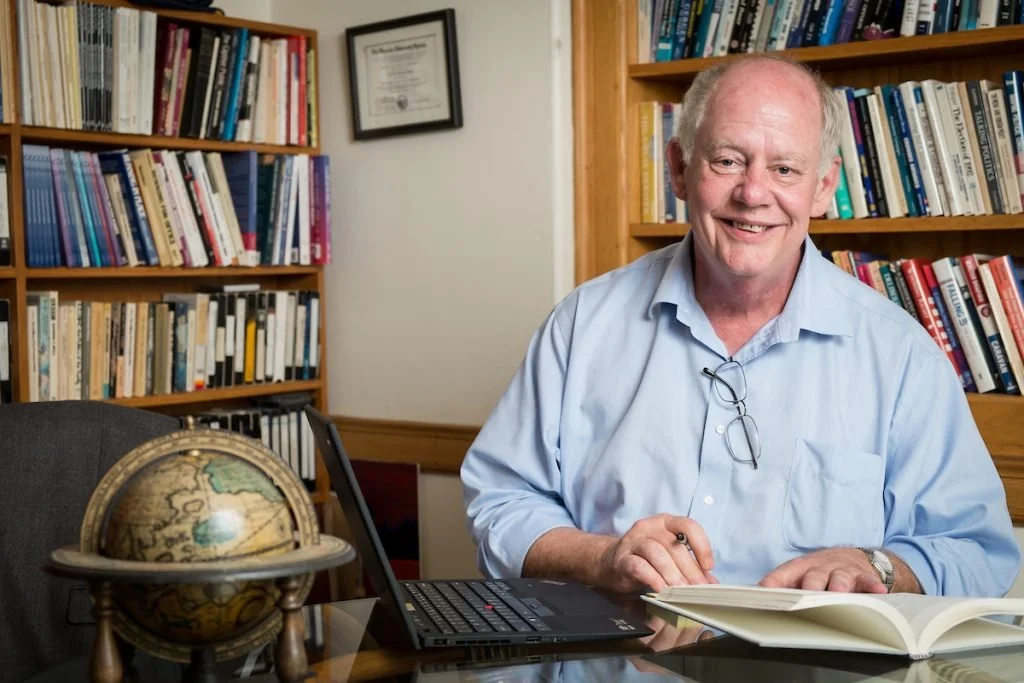
A Powell Rendezvous
A personal reflection by former program director Allan Louden, capturing his time at Northwest College from 1972 to 1977. Through vivid memories—from unexpected travel experiences and harsh Wyoming winters to the growth of a competitive and spirited team—the article highlights the early development of the forensics program and the people who shaped it.
More than a timeline, it tells the story of a community built on connection, competition, and unforgettable moments that continued to matter long after the final round.
A Powell Rendezvous
Memories from a past program director, 1972 -1977
Allan Louden, Emeritus Professor, Wake Forest University
My first encounter with Northwest Community College began with an interview—and my first airplane flight. Traveling from Missoula, Montana, to Powell during a stark winter storm proved harrowing. Multiple landings and relentless turbulence had my fingernails digging into the upholstery. We puddle-jumped from one rural Wyoming airport to another, seeking passage to Cody. At one point, the interview itself nearly vanished when a bull moose refused to vacate the runway at the unscheduled Jackson Hole landing.
Upon arrival in Powell, however, I was given the warmest welcome. The eternally optimistic Charlotte Patrick guided me along the way, beginning a friendship that has endured ever since. Her kindness has never waned. After my last interview, a protracted meeting with College President SinClair Orendorff, he extended his best wishes and personally drove me the thirty miles to the Cody airport. His counsel and steady judgment undoubtedly shaped my six years at Northwest Community College.
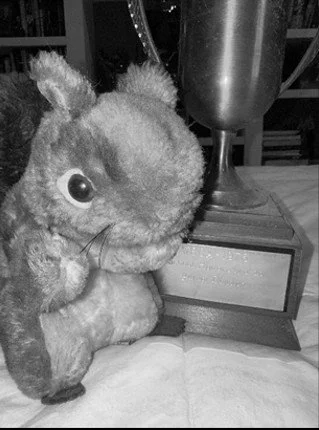
The Original “Squirrel Squad” mascot, attending from N.C.
Janette Smith (Division Chair) and Winifred Wasden (Head of English) occupied offices that bookended my own. Their guidance and friendship defined those early years. It was an era when one could still smoke in the office. By sheer happenstance, I once managed to set my office on fire and was quickly rescued by the campus supervisor. Janette and Winifred, to their credit, did not serve an eviction notice. Unsurprisingly, in those years, there were numerous faculty members who left a mark, such as John Hinkley (History)and Kermit Herd (Drama).
My early teaching years were intense and exhilarating, scrambling daily to stay ahead of several classes. I managed to dodge the dreaded “Public Speaking” assignment after the first year, though my memory of that initial class remains vivid: the back row filled with cowboy hats and personal spittoons. Even for a Montana farm boy, that was jarring. Yet one of the first speeches—an expose on how to hypnotize chickens—restored a sense of familiarity.
Intrinsic to the program were the 150 competitors who defined my short six years. There were scores of winners and even a few hangers-on, all of whom wove the very fabric of the "squad." Over the years, there were so many luminaries, both in competition and in character. As a representative example, we remember Scott Sanders, a loyal alumnus who brought home bushel baskets of trophies, elevating an already successful squad to a new level. There are too many notables to mention here, but each one’s fashion uplifted our journey.
I used to joke that, despite the college majors of “typing, welding, and horsemanship”—a partially unfair summary—that wholly competitive teams can be developed anywhere: “there are smart people everywhere.”
You can’t help but catch your breath remembering audiences weeping at the conclusion of Sandoval’s poetry reading, or the time NWCC swept the top three places in Duo-interpretation at the Rocky Mountain College tournament—with teams composed entirely of debaters. I still recall a jazzed squad at the Chicago Phi Rho Pi Nationals, swearing over a raucous German restaurant meal that they would return every ten years to reaffirm their bond.
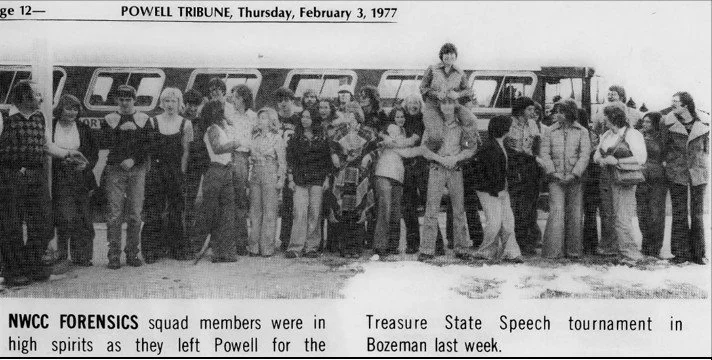
Don’t miss Charlotte Patrick atop Nebraska’s Billy Petty (center right). Duane (right) and I (left) flank the departing throng.
The debate squad I inherited had a solid history and strong standing within the school, but was thin on returning debaters—an eternal challenge at a two‑year institution. Only one debater came back: Joe, the eldest of the Singer clan, whose siblings graced the program for several years. We added a formidable debate transfer from the University of Montana, Virginia “Fish” Fischer, who would later become the long‑serving debate Assistant Director and Associate Dean at Northwest. Participation steadily grew, and six years later, five of us were coaching: Charlotte, Duane, Virginia, Melanie Holt, and me. On occasion, we commandeered the College’s large Trapper bus, packed it with competitors, and hit the road.
A major turning point for the program came with the hiring of Duane Fish as Assistant Director of Forensics. Fresh from completing his MA at Wichita State, Duane joined the staff and—incidentally, the next fall—became engaged to Virginia Fischer while the two were helping run the state high school speech tournament at Casper College. Their subsequent summer Montana wedding yielded two extraordinary long‑term coaches for the Northwest program. Their stewardship left an indelible legacy.
Internally, the team became known as the “Squirrel Squad,” a nod to our inventive speeches and eccentric affirmative case structures. To this day, I have retained two physical memories that are telling: the original Squirrel mascot and our first major sweepstakes trophy (JV), won at the massive Western States Tournament at Cal State Fullerton. I knew we had “arrived” when Lucy Keele, the tournament host and grand dame of college debate, sought me out to congratulate the team. The nobodies had a presence.
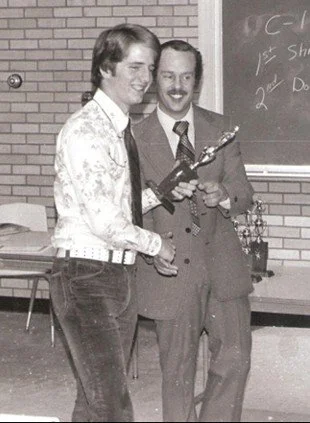
Another “Trapper Rendezvous champion was crowned, circa 1975.
One especially memorable trip took us to the University of Montana at the end of my final year. We won more than our share, and team esprit de corps was at full throttle. I awoke during our return interstate passage toward Bozeman to discover the entire side of our bus “mooning,” a Bozeman high‑school band bus. My entire career flashed before my eyes, yet no repercussions materialized—perhaps the band leader had a charitable sense of humor. In the last three years, the squad was almost too spirited, flooding campus with slogans, T‑shirts, and memorabilia. The rodeo team and the speech team defined campus bragging rights.
Those six years were filled with extraordinary moments, beginning with preseason retreats ranging from the Pinnacle Ranch in Dubois, Wyoming, to a camp outside Yellowstone Park. The team routinely hosted college and high school tournaments, a tradition that has continued uninterrupted for more than five decades. I do not recall who coined the college tournament’s moniker, the “Trapper Rendezvous, " but the name fit perfectly, capturing both the college’s identity and the spirit of gathering.
Each year, the squad arranged dozens of community presentations, ranging from debates for civic and educational assemblies to elaborate evening programs featuring original oratory, oral interpretation, and readers’ theatre. Some speeches were so poignant that tears were shed. These performances engaged the wider community while showcasing the students’ versatility and talent.
In 1976, the home program went international. In the fall, we hosted a debate team from New Zealand on the question, Is America still a European colony. NWCC’s Pat Hinkel upheld the affirmative and regular-season partner, Bruce Parker, debating on the negative.In the spring, we welcomed a delegation from the then‑USSR to debate the extent to which revolutions bring about fundamental societal change. Martha Bell, Scott Sanders, and I engaged in the debate. I mostly recall heightened security, citywide receptions, and the delegation’s eagerness to shop—stockpiling razor blades and other Western goods unavailable back home. Attracting the prestigious national Russian tour to the Wyoming countryside was considered quite a coup.
The team worked hard and won often, but they also knew how to celebrate. True to tradition, they could party with Wyoming eagerness. Someone would ignite their dancing gene, phone calls would cascade, and within the hour, nearly the entire speech team—students and coaches alike—would be dancing at a local disco. I vividly remember an epiphany, probably while prancing to a Donna Summer ballad, “knowing” I would return for a Doctorate, and it would be at the University of Southern California. The moment had no standing, but the circumstances would indeed come to pass many years later.
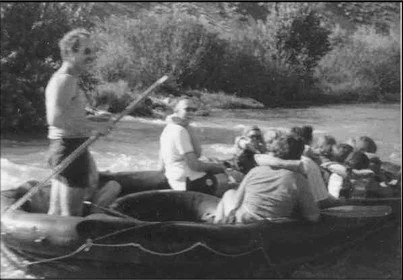
Summer of 1973 White Water Guide on the Shoshone River, Guide name “Fatal”
One summer, several debaters, including myself, became whitewater river guides in Cody, Wyoming, selling tickets by night and careening down the Shoshone River canyon by day. We were employed by a novice Northwest debater, the young Kit Cody, great-grandson of the (in)famous Wild Buffalo Bill Cody. Oh, to be that young again. The squad became a social refuge, the center of friendship and entertainment for the speech participants.
Powell’s weather, I must admit, left much to be desired. Long-term residents might agree even as they weigh other ties to Powell as more important. Nonetheless, one winter, electricity vanished from Powell to Billings—one hundred miles of darkness. Cars disappeared beneath snowdrifts, and burrows connected academic buildings. Another winter brought three straight weeks of twenty‑below temperatures. We escaped briefly to an Arizona tournament, a two‑day drive each way. Our three teams were joined by three debate teams from the University of Anchorage, with their coach, an old friend, Vicky Christie. Before we were done with our plug-in-your-cars cold spell, we snuck in a tournament at Montana State with our Anchorage fellow travelers. Searching for something encouraging about Wyoming mountain weather still proves, for me, a challenge.
There were countless long drives across the West—from the open prairies en route to Omaha, four-day driving trips to California and Arizona. And on to Chicago, Berkeley, and Los Angeles for national tournaments. During Carter’s gas crisis, we sometimes needed two gas tanks attached to our van simply to reach the next open station across the Arizona desert. There were blizzards before Logan Pass, trying to outwit the Highway Patrol, which had closed the highways. Those long van rides forged community. With an attentively balanced Risk board on our knees for hundreds of miles, we occasionally took a break to overwhelm a small-town restaurant with our unruly contingent.
The six years at Powell were formative and deeply rewarding. Late in my final season, I interviewed at Wake Forest University in faraway North Carolina. To my surprise, Wake Forest University extended an offer. I was perfectly content at Northwest and, until May, fully expecting to return. The decision was genuinely painful. I remember sitting in my car, shedding tears at the thought of leaving the Powell community. After counseling with many, a long conversation with President Orendorff proved pivotal. He offered a higher salary, assumed tenure, and continued financial support—then wisely advised, “You most likely should take it.”
Some moments in life require rolling the dice. Joining a top university was one such turning point. I have returned to Northwest many times over the years, even getting married in the Hinkley library. Each visit reinforces how profoundly those six years at Northwest Community College shaped my life. “Grateful” alone is not a sufficient précis.